The Cut2Size Angle

Classic Cars – in stainless steel!

February 18th, 2010

image

Stainless steel cars – pre-DeLorean: Check them out here.

See our article the January 2010 issue of Modern Metals!

February 17th, 2010

We were featured in the (very) niche trade magazine Modern Metals in January, along with our software partner Compusource. In addition to seeing a cool shot of our brass round bars, you can read how we worked together to make the website.  If for some reason you’re not a regular subscriber, the article is here.

Custom Harley Davidson Frame Grill

January 18th, 2010
The Cross and Flames is one of the many styles available.

The Cross and Flames is one of the many styles available.

We’ve been working with our friends at Old Jim Customs (OJC) on some exciting new custom parts for Harley Davidson motorcycles.  We laser cut their original designs out of aluminum for use in an entirely new product for Harleys: custom frame grills. What is a frame grill?  In the picture to the right, it is the cross and flames you see behind the front wheel.  Another option is the Cigar Skull, also pictured here.   OJC is offering a wide variety of designs, but can also do custom designs if you can’t find exactly what you want.  They also offer head plates and other chrome accessories (coming soon), so if you’ve got a Harley, check them out!

Custom Frame Grill Design - Cigar Skull

Custom Frame Grill Design - Cigar Skull

Two easy ways you can help Haiti

January 16th, 2010

On October 16, 1999, I was in California for a Sheet Metal & Air Conditioning Contractors National Association (SMACNA) convention. At 2:45 in the morning, we were startled awake when our hotel began to swing like a hammock. Forty-five seconds later, it was over.

An off-duty police officer brought water to distribute to a large crowd near the airport

An off-duty police officer brought water to distribute to a large crowd near the airport.

The next morning we discovered we were about 60 miles from the epicenter of the Hector Mine earthquake, a 7.0 magnitude earthquake felt as far way as Carson City, Nevada. Terrifying as it was, we were in a state where building codes require earthquake resistance, and there was relatively little damage.
The 7.0 magnitude earthquake in Haiti occurred 16 miles from the capital. Many public and governmental buildings have collapsed, and millions in the capital are still without food, water and medical care. Below are two easy ways to help. Please count your blessings and then donate to relief work in Haiti.

My favorite way to help: Partners in Health (PIH) is an organization that focuses on health care for poor around the world. Since they began in Haiti in 1983, they are on the ground there and already helping, but are quickly running out of supplies. You can read the inspiring story of PIH in Tracey Kidder’s Pulitzer prize-winning book Mountains Beyond Mountains. Click this button to donate to Partners in Health:

Stand With Haiti

The easiest way to help: Filling out a few fields feel like too much trouble?  Then text the word HAITI to 90999 to donate $10 to American Red Cross relief for Haiti. (You will receive a message asking you to confirm; hit the reply but and text YES back. On AT&T at least, the text messages appear to be free).

We have been using 8mm cast aluminium tooling plate for our heat sealer plates running at around 110 to 160 degrees with no problem. Just testing a new machine using 6mm plate MIC6 at temperatures between 150 and 240 degrees and patchy seal suggesting plate deformed. Is this likely?

December 7th, 2009

David F.

Thanks for the question, David! Cast tool and jig plate usually gets a thermal stress relieving treatment that imparts thermal recyclability into the product. Typically, it can be heated repeatedly to temperatures as high as 800°F (427°C) and, when cooled, will return to its original dimension with a minimum of distortion, depending upon the extent of machining.  Without knowing what forces are on your sealer plates, it would be hard to say if the heat resulted in the deformation.  The plate is designed to take some heat, but you may want to check with your aluminum supplier.  Since the composition of cast tool and jig products like MIC6 are proprietary,  they would need to tell you if you particular product could have deformed under these circumstances.

A Brief Guide to Aluminum Sheet Alloys and Tempers

December 4th, 2009

ash-1As an aluminum supplier, we can offer you nearly any alloy of aluminum sheet you need.  We find that the vast majority of customers, though, use 6061-T6 or 3003-H14.  These designations may look cryptic, but they’re really pretty simple.  The first part, the four digit number, is the alloy.  The part after the dash is the temper.  Let’s break these down and look at them separately.

Alloy

The first of the four digits in the alloy indicates what the primary alloying element is.  The chart below list some of the available series.

Series Primary Alloying Elements
1000 Aluminum
2000 Copper
3000 Manganese
4000 Silicon
5000 Magnesium
6000 Magnesium & Silicon

The second digit can indicate if there are impurity limits or other modifications to the alloying elements. Generally, the third and fourth digits identify the alloy or indicate the purity of the aluminum. In the 2000 through 8000 series, however, the last two of the four digits have no special significance but serve only to identify the different aluminum alloys in the group.

Temper

At Cut2SizeMetals.com, we offer 2 tempers: strain-hardened only (H14 temper) and solution heat-treated and then artificially aged (T6 temper). The number “4″ in H14 means that tensile strength is half way between the O temper and 8 temper, sometimes called half-hard. The combination of the 3003 alloy and the H14 temper makes for a softer, more formable aluminum. The 6061 alloy in the T6 temper is a stronger, stiffer aluminum that is used where strength, and not formability, is important. If you’d like to talk to us about your specific application, give us a call at 812.429.1634.

Machinability of Aluminum Rod

November 23rd, 2009

Aluminum Round

First off, we’re not machinists, but we can pass on what the metallurgists tell us.  Use what you read below as a general guideline, but remember that we’re not offering advice on your particular project. [Our lawyers wanted that last disclaimer to be longer and wordier, but you know what we mean!]

Here are some alloys that are available.  We stock 6061 because we find it to be the best combination of machinability, corrosion resistance, weldability, and ductility.   [That last one has nothing to do with fowl or tape; it just means "capable of being drawn out into a wire or thread."]  We also carry 6063-T5 but it is softer, and more formable, and not designed for machining. If you need the other alloys below, just give us a call at 812.429.1634.
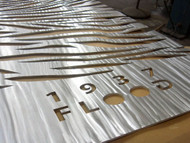
Screw Machine Stock

2011-This alloy offers the highest machinability of all aluminum rod.  Excellent machinability; and relatively low cost make 2011 the most used screw machine alloy. Alloy 2011 is not recommended for welding or brazing, and it exhibits poor corrosion resistance. Typical applications are wiring devices and fittings, radio and TV components, optical parts, and electrical components.

2017-This alloy rates lower in machinability than 2011-but it provides slightly greater strength, better corrosion resistance, and easier welding than 2011. Alloy 2017 is also recommended for deep drilling. Typical applications are brake pistons, hinge pins, pulleys, and camera parts.

2024-This alloy has the highest tensile strength of all the aluminum screw machine alloys. It is recommended for parts that require consistent high strength. Welding characteristics and corrosion resistance are similar to 2017. Typical applications are aircraft parts, fasteners, couplings, hydraulic valve bodies, and orthopedic braces.

6061-This alloy doesn’t machine as well as the other screw machine grades, but it does offer excellent corrosion resistance and excellent welding characteristics. It is also the most ductile of the screw machine alloys. Typical applications are hydraulic pistons, decorative hardware, door knobs, handrail fittings, and valves.

6262-This alloy is second only to 2011 in machinability. It combines strength, excellent weldability, and good corrosion resistance to make it the best all-around screw machine alloy. Typical applications are marine hardware, hydraulic pistons, marine diesel fillings, and couplings.

Non-Screw Machine Stock

1100-This alloy is 99% pure aluminum and, therefore, very poor in machining qualities. It does exhibit excellent electrical and thermal conductivity, excellent corrosion resistance, and outstanding welding characteristics. Typical applications are decorative parts, cold threaded parts, and welding rod.

7075-This is the, highest strength aluminum rod or bar available. It also has machinability equal to 2017 and 2024. This alloy is not considered a screw machine grade because 7075 cannot meet screw machine straightness tolerances due to its high strength. This is a poor welding grade and has only average corrosion resistance. Typical applications are aircraft parts.

ZaneRay Group describes how they make the magic that is Cut2SizeMetals.com!

November 19th, 2009

cut2sizemetals-logo-200x200

While we take credit for the scintillating descriptions and witty content of Cut2SizeMetals.com, the logo design, visual navigation, database, shipping, inventory tracking, and all the cool stuff it does comes from our friends at the ZaneRay Group. We think they’re as good at web design as we are at fabricating aluminum, stainless steel, brass, and copper!  Here is their story about how we worked together to bring you Cut2SizeMetals.com:

ESMW ESTABLISHES NEW BENCHMARK FOR ONLINE CUSTOM INDUSTRIAL AND ARCHITECTURAL FABRICATION

Guide to Cast Tool & Jig Plate

November 17th, 2009

Aluminum Plate

What is aluminum cast tool & jig plate? It is a high-quality, accurately machined aluminum plate that has received a thermal stress relieving treatment to provide dimensional stability during machining.  Typically, it can be heated repeatedly to temperatures as high as 800°F (427°C) and, when cooled, will return to its original dimension with a minimum of distortion, depending upon the extent of machining.

While the hardness will vary considerably with the thickness due to the thermal treatment, the plate will still retain good machining characteristics. Cast tool and jig plate is of the 7000 series-type alloy,  and at Cut2SizeMetals.com, we stock 1/2″ thick material.  If you need thicknesses ranging from a .250 in. to 4 in., give us a call at 812.429.1634.  The exact alloy composition is proprietary; however, it has been in use successfully for decades. This product offers good resistance to general corrosion. Since most applications of this precision product are sheltered from atmospheric and industrial environments, no special protective measures are usually required.

Tolerances

Surface Finish:  (2 Sides) <25 Microinches


Flatness Tolerance

Flatness Plate Thickness, inches Max Deviation from flat, inches
1/4 – 5/8 .015
Over 5/8 .005


Thickness Tolerance

Thickness Specified Plate Thickness, inches Max Deviation from flat, inches
.250 – 4.000 ± .015
Source: CS&W

A Brief Guide to Brass Sheet, Plate, Bar and Round

November 3rd, 2009
Brass Round | Brass Rod

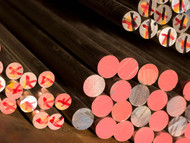
Just a few of the sizes of brass round we stock.

As a brass supplier, we can offer you nearly any alloy of brass you need.  We find that the vast majority of customers, though, use alloy 260 or alloy 360.

Alloy 260

Our brass plate and sheet come in alloy 260, or as it is better known to our customers, yellow brass or cartridge brass (so called because it is used to make shell casings).  We stock the half hard temper, which has an approximate Rockwell B60-77.

Alloy 360

The extrusions we carry in brass (square bar, rectangular bar, and round) are alloy 360, known as free machining brass.  As the name implies, it has good machinability, but it is not suited for forming applications.   Like the sheet and plate, we stock half hard temper.  You can find more information by clicking on the little “Need Help Choosing?” buttons.

If you need 330 brass, naval bronze, or some other exotic alloy, give us a call at 812.429.1634; we can usually get it for you.

Next Entries »